

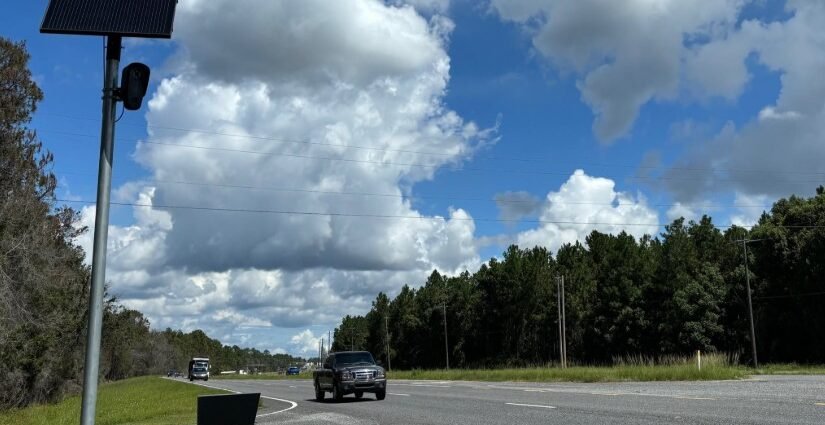
Several Northeast Florida law enforcement agencies are discontinuing the use of automated license plate readers following a Florida Department of Transportation directive and growing concerns over privacy, data sharing and government oversight of the technology.
The Clay County Sheriff’s Office, Jacksonville Sheriff’s Office and Putnam County Sheriff’s Office announced they are removing or disabling license plate reader systems that have been used for years to locate suspects, recover stolen vehicles and find missing people.
Clay County officials said all license plate readers will be removed from county roadways in response to an FDOT memo.
The Sheriff’s Office has used license plate readers since 2018 and described them as a valuable crime-fighting tool.
During the past year, the technology helped Clay County deputies locate a missing 76-year-old South Carolina woman whose vehicle was detected in Middleburg. The system also helped investigators identify and locate a homicide suspect in a fatal stabbing.
In another case, authorities used a license plate reader to help locate a 10-year-old taken during a child custody dispute. The vehicle was eventually stopped near the Florida-Alabama state line, resulting in three arrests.
Sheriff Michelle Cook said removing the cameras would not change the agency’s broader approach to public safety.
“This decision does not hinder, nor sway, our efforts to prevent and fight crime, solve cases, hold offenders accountable and maintain public trust,” Cook said.
In neighboring Duval County, Jacksonville Sheriff T.K. Waters went a step further.
After FDOT announced it was revoking permits and licenses allowing law enforcement agencies to operate license plate readers on state roads, Waters ordered the Jacksonville Sheriff’s Office to discontinue use of the technology throughout Duval County, effective immediately.
Waters acknowledged that license plate readers have helped Jacksonville investigators solve serious crimes and locate missing and vulnerable people.
But he said community concerns, combined with the state’s decision, led him to shut down the system.
“Given the decision made at the state level and the concerns expressed by members of our community, I have determined that discontinuing the use of this technology is the appropriate course of action at this time,” Waters said.
Putnam County Sheriff H.D. “Gator” DeLoach also ordered his agency’s automated license plate reader cameras disconnected immediately. All 18 cameras positioned along major Putnam County roadways are expected to be removed within 30 days, and the Sheriff’s Office plans to cancel its contract for the technology.
For DeLoach, the issue extends beyond the FDOT action.
“Over the past several weeks, legitimate questions have continued to emerge regarding privacy, data sharing, governmental oversight and the future regulation of this technology,” DeLoach said.
Putnam County began using automated license plate readers in 2022.
Since then, the cameras have helped deputies find people with Alzheimer’s disease and early-stage dementia who became disoriented while driving. The technology has also been used to track and arrest murder suspects.
Earlier this year, Putnam County deputies and the FBI used the system to locate an out-of-state teenage human trafficking victim, according to the Sheriff’s Office.
Despite those successes, DeLoach said advances in license plate recognition technology are moving faster than the laws regulating it.
“Until that framework catches up and provides clearer, more consistent safeguards for both public safety and individual privacy, I believe discontinuing the program is the most responsible course for our agency and the community we serve,” he said.
Putnam County required deputies using the system to associate searches with a case number and conducted quarterly audits of information being accessed. DeLoach said he remains confident his deputies used the technology lawfully and responsibly.
His concerns include how license plate reader systems are being used elsewhere. The sheriff pointed to reports of misuse involving other law enforcement agencies and privately operated cameras across the country.
DeLoach said Putnam County will not resume using the cameras unless Florida lawmakers establish clearer parameters and guidance for law enforcement.
“Public safety matters. So does individual liberty,” DeLoach said. “Neither should be treated casually.”